Roof decking is the layer of boards or panels your shingles are nailed to, and when it rots the roof starts to feel soft underfoot, dip between rafters or let go of nails that no longer bite. Roof decking repair in Little Rock usually means opening one section, cutting out the bad wood back to solid framing, installing new sheathing and re-shingling, then fixing the leak or attic moisture that started the damage. Call (773) 207-0769 any hour to line up a licensed roofer.
Rot is common here for plain reasons: about 50 inches of rain a year, much of it in downpours, attics that stay hot and humid for months, and a median house built around 1978 that may have hidden a slow leak for years. Pre-war Hillcrest, Heights and Quapaw Quarter houses usually have board decking, while newer west Little Rock and Chenal Valley homes have plywood or OSB. The roofers we work with repair both, across the city and the cities we serve around Little Rock.
Signs your roof decking has rotted
Decking trouble shows up on the roof surface, along the roofline and in the attic. You can check two without a ladder.
From the yard
- A sagging line or shallow dip between rafters, easiest to spot in low morning or evening light
- Shingles that look wavy or sunken over one patch while the rest of the slope lies flat
- Gutters pulling away from a soft fascia board, or paint peeling and flaking along the eaves
In the attic
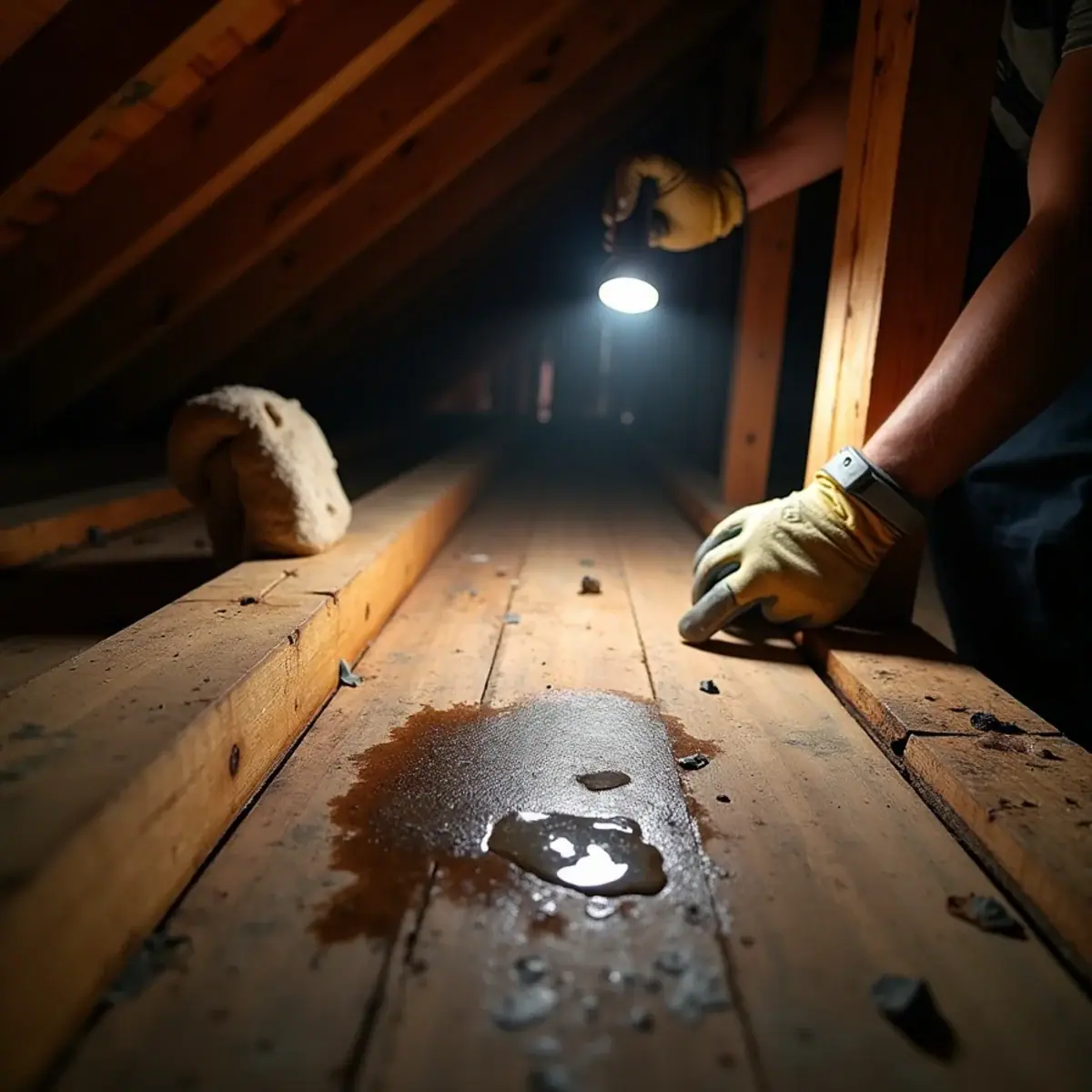
- Dark stains, black streaks or white mineral rings on the underside of the boards or panels
- Plywood or OSB that is swollen at the edges, peeling in layers or crumbling around nails
- Rusty nail tips, or pinpoints of daylight where there should be none
- A musty smell, or mildew on the sheathing and rafters by late summer
Underfoot
A roofer walking the slope often feels a springy spot before anything shows below. If you find one while cleaning gutters, step off and stay off. Our guide to the signs of rotted roof decking goes through each warning sign in more detail.
What a decking repair includes
A decking job covers more than swapping wood. The roofer opens the area, rebuilds it and deals with whatever made it rot. A typical visit includes:
- A roof walk and attic check to map where the soft wood starts and stops
- Removal of shingles and underlayment over the damaged area and a margin around it
- Rotted planks, plywood or OSB cut back to solid rafters and replaced with sheathing of matching thickness
- Rafters and rafter tails under the opening checked, with minor softness sistered
- New underlayment, shingles woven into the existing roof and flashing reset where needed
- Fascia, soffit and drip edge repairs when the rot reaches the eaves
- Photos of the opened deck and a written note on what caused the rot
How a decking repair gets done, from first call to finished roof
Rot hides, so most of the work happens before anyone cuts into the roof.
- Call and describe what you seeTell us about the soft spot, sag or stain and where it is. Phones are answered 24/7, and a licensed roofer is lined up for a dry day.
- Roof and attic inspectionThe roofer walks the slope, checks the attic with a light and probes suspect wood to estimate how far the rot runs and what caused it.
- Written estimateYou get the price in writing, including how extra rotted sheets would be handled if more turns up once the roof is open.
- Repair dayThe section is opened, bad wood is cut out, framing is checked, new sheathing goes down and the area is dried in and re-shingled.
- Fix the causeFlashing, pipe boots, gutters or attic ventilation are corrected so moisture stops reaching the new decking.
What causes decking rot: slow leaks, poor ventilation and humidity
Wood decking rots when it stays damp long enough for fungi to take hold. In Little Rock that moisture arrives from two directions: rain getting in from above and humid air condensing from below.
Slow leaks from above
The worst rot usually sits under a small leak that never reached a room. A cracked pipe boot, a gap in chimney step flashing or a valley packed with oak leaves can wet the same patch of decking every heavy rain for years while the ceiling stays clean. Stopping that source is part of the job, through roof leak repair or flashing and chimney leak repair.
Moisture from below
A poorly ventilated attic holds the damp air of an Arkansas summer, and on cold nights that moisture condenses on the underside of the decking. Ventilation rot tends to show as a broad stain near the ridge or on the north slope, not one wet spot. Bathroom fans that blow into the attic make it worse.
Leaks that only appear in hard rain still rot wood
Our post on why roofs leak only in heavy rain lists the usual causes.
Mold, stains or rot? Reading the underside of the decking
Dark marks on the attic side of the roof worry a lot of homeowners, but not every stain means the wood has to come out. The first question the roofer answers is simple: is the wood still firm?
- Firm wood with surface mold or staining. An awl will not sink in and the plies hold together. The sheathing is usually still sound. The repair is stopping the moisture, and the mold is cleaned or treated rather than the deck torn out.
- Soft, punky or layered wood. The tip sinks in easily, plies peel apart or the surface crumbles around nails. That section has lost its strength and gets replaced.
The pattern points to the source
- A broad, even darkening near the ridge or across the north slope usually means condensation in an attic that holds damp air.
- A dense patch right above a bathroom fan, range hood or dryer line usually means that duct ends in the attic instead of outdoors.
- A narrow stain running downhill from a vent pipe, chimney or valley usually means a leak above it.
On decking, mold is mostly a warning that the wood has been staying wet. The EPA's home mold guidance says homeowners can usually handle areas smaller than about 10 square feet themselves and should follow its fuller guidance for anything larger, so where growth is widespread the roofer may suggest a mold specialist alongside the roof work.
How a decking repair works: open the section, replace the sheathing, re-shingle
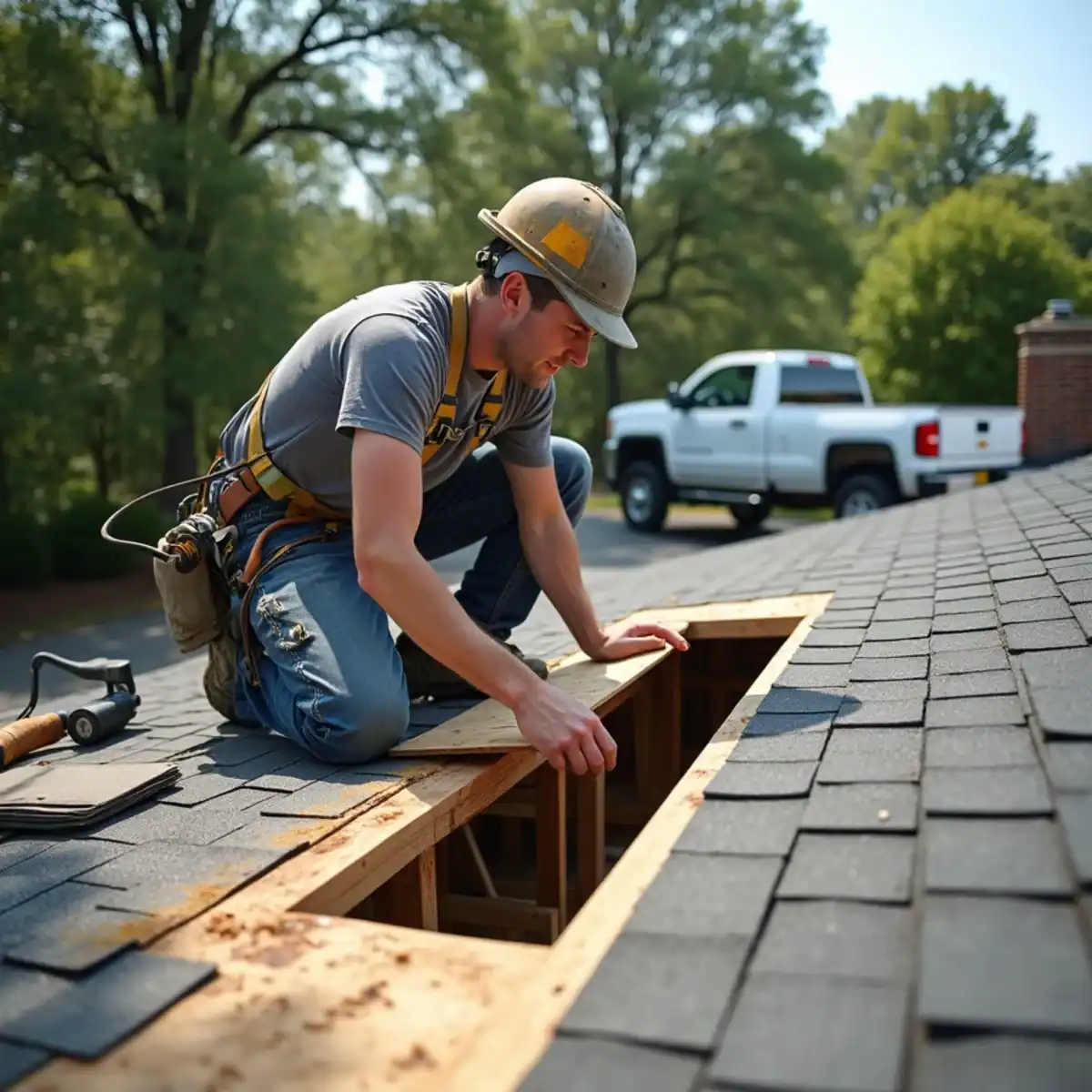
A decking repair is a small tear-off and rebuild of one area of the roof. On most homes it follows the same order:
- Map the damage. The roofer walks the slope and checks the attic to see where the soft wood starts and stops.
- Strip the shingles and underlayment over that area plus a margin of sound roof.
- Cut out the rotted wood back to the center of the nearest solid rafters, so the new piece has framing to fasten to on both sides.
- Check the framing. Rafters under the opening are probed. Minor softness is sistered with new lumber; anything structural is flagged first.
- Install new sheathing of matching thickness, gapped slightly at the edges so it can swell in humid weather without buckling.
- Dry it in and re-shingle. New underlayment goes down, then shingles woven into the existing roof, with flashing reset wherever the repair meets a wall, chimney or vent.
Many single-area repairs are done in one day of dry weather. Our missing and damaged shingle repair page explains how new shingles are blended into a sun-faded roof.
Decking thickness, rafter spacing and edge clips
A patch only works if it matches the deck around it. A thinner sheet leaves a dip the shingles show, and a thicker one leaves a ridge. Before buying material, the roofer measures the old sheathing at the cut edge and checks how far apart the rafters or trusses sit.
What Little Rock roofs are usually built with
- Panels: most homes from the 1970s on have 7/16-inch OSB or 1/2-inch plywood, and some have 5/8-inch plywood.
- Framing: rafters or trusses are usually set 16 or 24 inches apart. At 24 inches a thin panel spans a long way unsupported, which is why some roofs with 3/8-inch sheathing dip between rafters even when the wood is dry.
- Boards: older plank decks are usually 1-by lumber, about 3/4 inch thick, so a plywood insert often needs a thicker panel or shims to sit flush.
How the new sheathing goes in
- Metal H-clips support panel edges that fall between rafters, which matters most at 24-inch spacing.
- Shingle nails need about 3/4 inch of solid wood, or must pass all the way through a thinner panel, so the patch has to be sound through its full depth.
Plywood or OSB for the patch?
Both work when they are gapped, fastened and covered quickly. They behave differently when wet: OSB tends to swell at the edges and stay swollen after it dries, which can show as raised lines under the shingles, while plywood swells more evenly and mostly settles back. Many swollen edges start with sheets butted tight, so the roofer leaves a small gap and usually matches what is already on the roof.
Plank decking on older homes vs plywood and OSB
What sits under your shingles depends mostly on when the house was built, and it changes how the repair is done.
| Board (plank) decking | Plywood or OSB panels | |
|---|---|---|
| Where you find it | Pre-war homes in Hillcrest, the Heights and the Quapaw Quarter | Most homes built from the 1970s on, including west Little Rock and Chenal Valley |
| How it rots | Board by board, often at the eaves and beside chimneys, with dark ends and loose nails | Panel edges swell and peel apart; OSB can soften across a whole sheet |
| How it is repaired | Bad boards swapped for lumber of the same thickness, or a section re-decked in plywood shimmed flush | Full or partial panels cut to land on rafters, with clips at unsupported edges |
| Watch for | Gaps between boards on some houses that first carried wood shingles, which need covering before new shingles go on | Thin panels on some 1970s and 1980s homes that dip between rafters even without rot |
Board decking around dormers and chimneys on a steep Heights roof takes slow hand work; an open plywood slope in Chenal Valley goes faster, and the estimate reflects it.
How much decking gets replaced, and what makes a repair grow
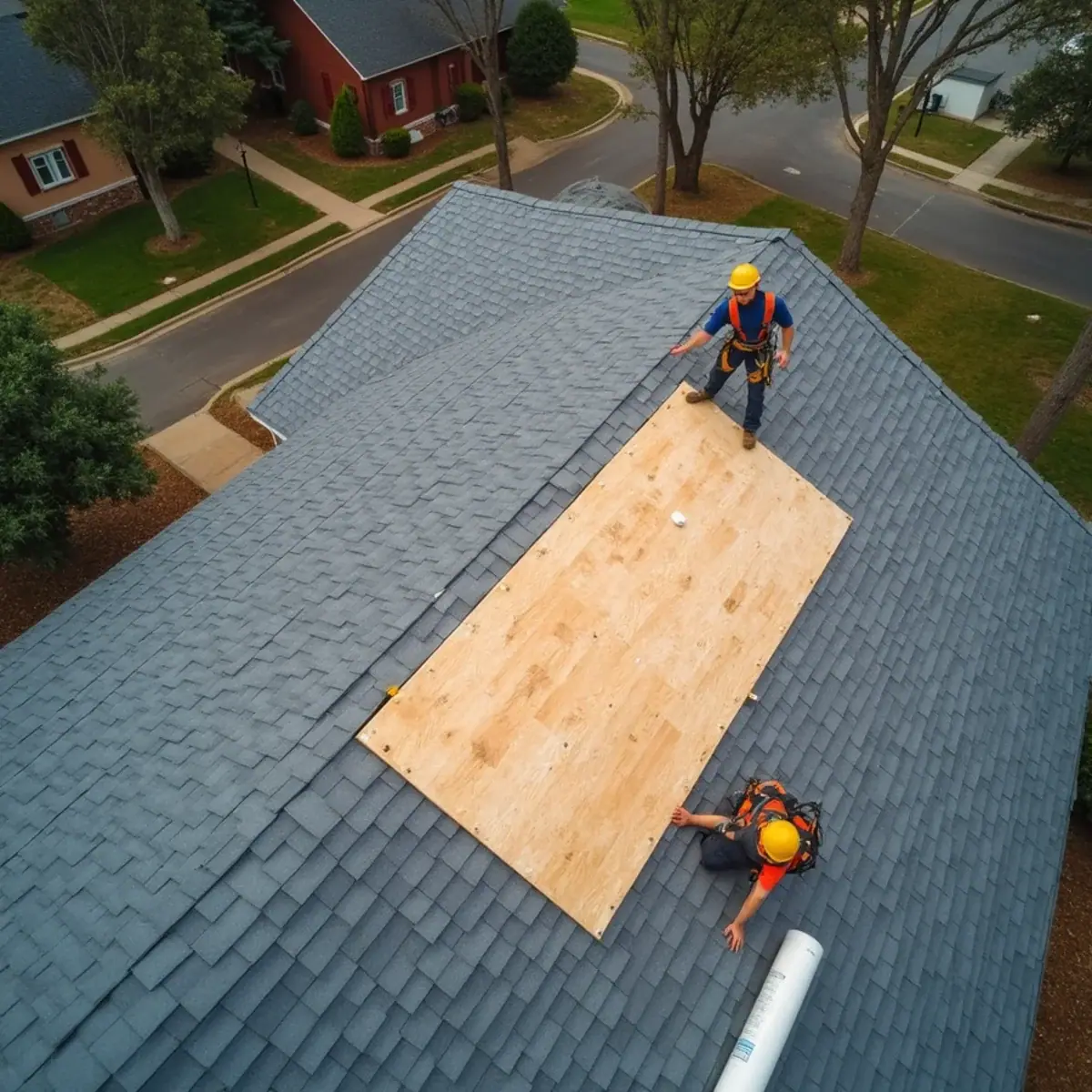
On most repairs the answer is a few boards or a sheet or two around the leak. The roofer estimates the size from the attic and the roof walk, but the true edge of the rot only shows once the shingles are off. A repair grows when:
- The rot runs past the stain. Water travels along the top of the deck under the underlayment, so soft wood often reaches beyond what showed in the attic.
- Rafters are soft too. Rotted framing under the opening is sistered or repaired before new sheathing goes on.
- Nails will not hold. Wood that looks fine but is too soft to grip a nail is cut back as well, because shingles fastened into it can let go in the next strong wind.
- Old boards have wide gaps. Some wood-shingle-era decks were laid with spaces between boards, and shingle makers commonly call for a solid overlay of at least 3/8-inch plywood or OSB once gaps run past about 1/4 inch. The roofer fills the repair area solid; covering a whole gapped slope is a separate decision.
If the opened area turns out larger than expected, the roofer stops and shows you the soft wood, with photos, before cutting further.
Fascia, soffit and eave rot
Every drop leaves the roof at the eaves, so rot often starts there. Clogged gutters overflow behind themselves, a missing drip edge lets water wick into the trim, and the lowest row of decking sits right above both.
- Fascia board: the trim board the gutter hangs on. Soft, split or peeling fascia is cut out and replaced, and the gutter is rehung on solid wood.
- Soffit: the underside of the overhang. Stained or sagging soffit usually means water has run behind the gutter, and a rotted panel lets squirrels in.
- Rafter tails: the rafter ends that carry the overhang. On older homes with exposed tails, a few may need sistering where they have gone soft.
- Drip edge: the metal strip at the roof edge that holds water off the fascia. Adding or replacing it belongs in any eave repair.
Under the oaks and pines of older Little Rock streets, gutters fill quickly every fall and again in spring. Keeping them clear is the simplest way to protect new eave wood once the repair is finished.
Attic ventilation fixes that stop rot from coming back
If moisture from below caused the rot, new decking alone will go the same way in a few years. Balanced ventilation pulls outside air in low at the soffits and lets it out high at the ridge, keeping the attic closer to outdoor temperature and humidity.
- Open the intake. Insulation blown over the soffit vents is common. Baffles hold it back so air can enter.
- Add exhaust up high. A ridge vent or correctly sized roof vents let hot, damp air escape.
- Avoid mixing exhaust types. A ridge vent next to a gable fan or extra box vents can short-circuit the airflow, pulling air from the nearest opening instead of the soffits.
- Send fans outdoors. Bathroom and dryer ducts that end in the attic get rerouted through a roof or wall cap.
The roofer sizes the vent area to your attic.
The same problem ages shingles
A hot, stuffy attic often curls shingles early too. Our post on attic ventilation and shingle life in Arkansas explains how the two are linked.
What affects roof decking repair cost
Decking work is priced after the roofer sees the roof and the attic, because rot usually runs further than the ceiling stain suggests. Our shingle roof repair cost guide for Little Rock covers general pricing factors. For decking, these matter most:
- How much wood is rotted, counted in sheets or square feet once the shingles are off
- Decking type: matching old boards takes more labor than dropping in a plywood panel
- Pitch, height and access: a steep two-story roof needs more safety setup than a low ranch
- Old shingle layers that must come off before the deck can be reached
- Framing repairs to rafters, the ridge board or rafter tails found under the opening
- Eave work on fascia, soffit and drip edge
- Ventilation changes such as a ridge vent, baffles or rerouted fan ducts
- Shingles needed to blend the patch into the rest of the roof
Hidden rot can turn up once the old wood is open, so ask how extra sheets would be handled before the job begins. The roofer gives you a written estimate before work starts.
Why Little Rock homeowners call Little Rock Shingle Roofers for decking repair
- Licensed, insured roofersEvery roofer we send is licensed and insured in Arkansas. Little Rock Shingle Roofers connects you with independent licensed roofers who perform the work.
- A written estimate firstThe roofer prices what can be seen, explains how hidden rot would be handled and puts it in writing before anyone pulls a shingle.
- Only the bad section is openedA few rotted sheets call for a section repair. The roofer opens what needs opening and leaves sound roof alone.
- Someone answers any hourFound a soft spot on a Sunday evening? Phones are answered 24/7, so you can report it right away and get a roofer scheduled.
Roof Decking Repair questions from Little Rock homeowners
Is a soft spot on my roof an emergency?
Usually not, unless water is coming inside or the spot has opened into a hole. A soft spot means wet or rotted decking that needs repair soon, not tonight. Stay off it, keep others off it and check the ceiling below after each heavy rain. If the area starts dripping, sags visibly or opens up, call (773) 207-0769 for emergency roof repair. Otherwise, book an inspection for the next dry spell.
Can decking be replaced in one section only?
Yes, in most cases. The roofer removes the shingles over the damaged area, cuts the bad wood back to the center of solid rafters, fits new sheathing of the same thickness, then dries it in and re-shingles. There is no need to strip a whole slope for a few rotted sheets or boards. A section repair stops making sense only when rot is spread across much of the roof, and that becomes a separate conversation.
How do roofers find rot without tearing off the roof?
Mostly from the attic and by feel. A roofer walks the slope and notes any soft or springy spots, then goes into the attic with a strong light to look for stains, peeling plies and rusted nails. Pushing an awl into suspect wood shows how deep the softness goes, and a moisture meter separates old stains from wood that is still wet. The exact edge of the rot is confirmed once the shingles come off.
Does a sagging roof always mean structural damage?
No. A dip between rafters is often decking that has softened or was thin to begin with, and that is a sheathing repair. A sag along the ridge or across several rafters can point to cracked rafters, a tired ridge board or missing collar ties, which is framing work. Some century-old houses have also settled a little. The roofer checks the attic and tells you which you have; if a carpenter or engineer is needed, you hear that first.
Can new plywood be patched into the old board decking on my Hillcrest or Heights house?
Yes. Roofers often replace a run of rotted boards with plywood, shimmed so the new surface sits flush with the old planks and the shingles lie flat. Where only a board or two is bad, matching lumber is used instead. Board roofs around chimneys and dormers take careful hand work, so the estimate reflects that. If the old boards have gaps from an original wood-shingle roof, the roofer covers them before new shingles go on.
Why is the decking rotting on my newer west Little Rock home?
Usually ventilation or a hidden leak, not age. The hip-and-valley roofs common in west Little Rock and Chenal Valley have long valleys and wall junctions where a small flashing gap can wet the OSB for years. Large attics with blocked soffit vents, or a bathroom fan blowing into the attic, trap summer humidity, and OSB swells when it stays damp. The roofer looks for both so the new decking lasts.
Is mold on the underside of my roof decking a reason to replace it?
Not always. If the wood is still firm when probed and the plies hold together, the decking is usually sound, and the real fix is stopping the moisture, whether that is a leak, a bathroom fan venting into the attic or blocked soffit vents. Decking is replaced when it is soft, delaminated or crumbling around nails. Widespread growth may also call for a mold specialist to handle the cleanup.
Can new shingles just be nailed over a soft spot?
No. Shingle nails need about 3/4 inch of solid wood, or must pass all the way through a thinner panel, to hold. Soft decking lets nails back out or pull through, the shingles above can loosen in the next windy storm, and the rot keeps spreading underneath. The soft section is cut out and replaced first, then shingled.
Page reviewed by Little Rock Shingle Roofers.