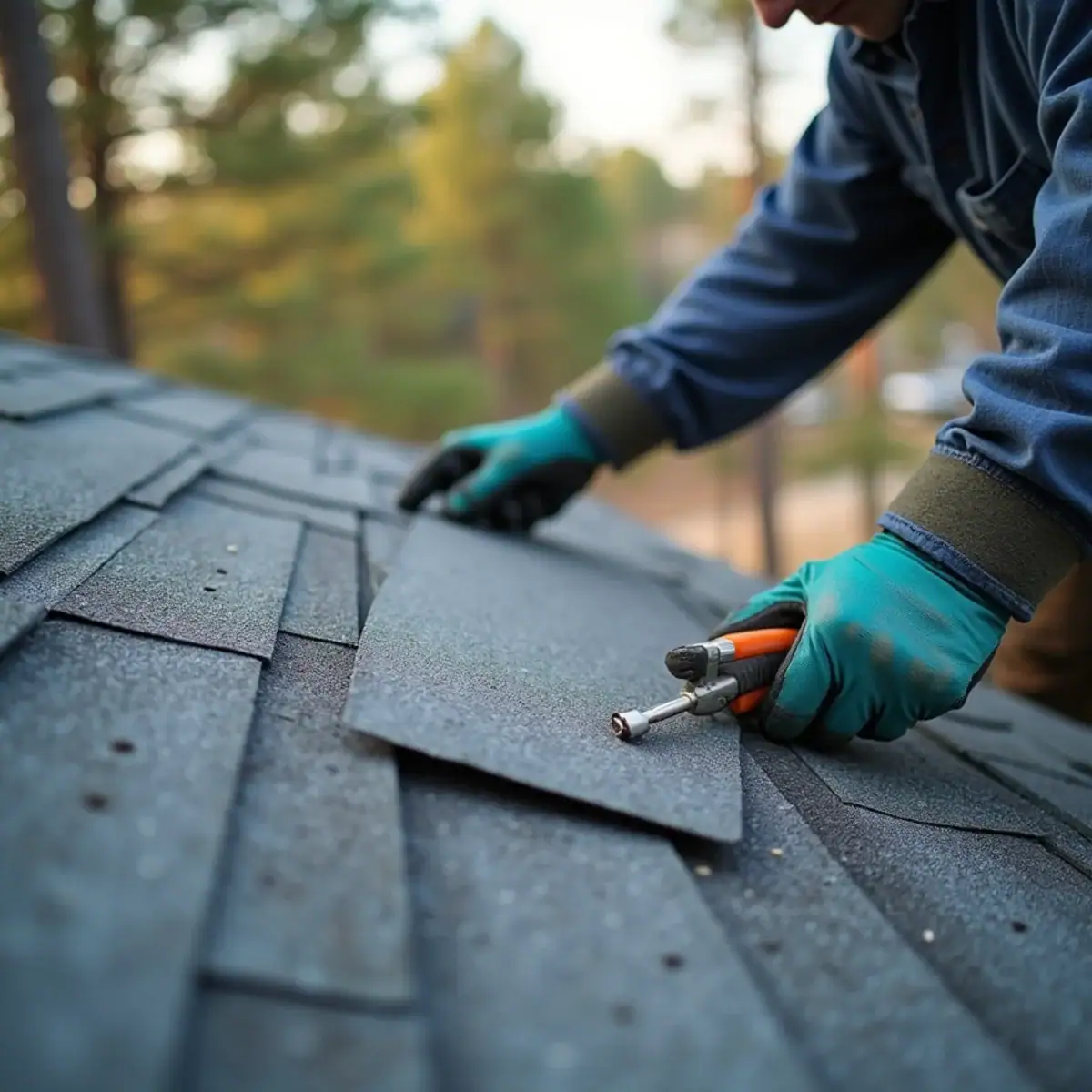
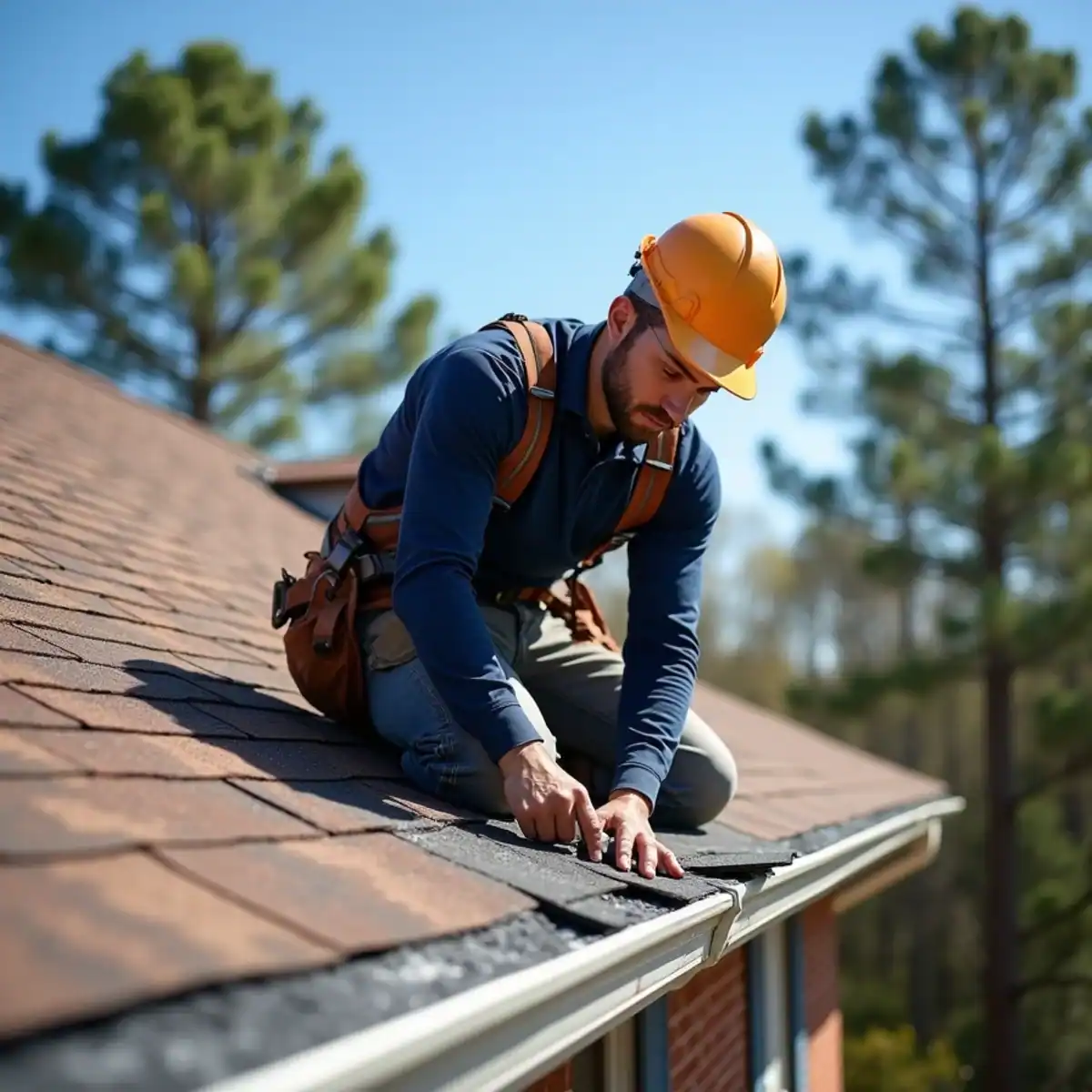
Missing shingle repair in Little Rock is usually a small job that prevents a bigger one. A gust tears off a few tabs, a pine limb scrapes a row loose, or a nail works its way up through the shingle above it. The underlayment beneath keeps the roof dry for now, but it was never meant to face July sun and 50 inches of rain a year alone. Once it tears, water reaches the deck.
Little Rock Shingle Roofers answers 24/7 and connects you with an independent licensed roofer who looks at the damage up close, matches the new shingles to the ones on your roof and gives you a written estimate before work starts. If water is already coming inside, start with roof leak repair instead. And if you found a shingle in the yard, keep it: it helps the roofer match the brand and color.
Shingle damage we repair: missing tabs, lifted, curled and cracked shingles, nail pops
Most shingle problems fall into a few types. Each points to a different cause, and the cause decides the fix.
Missing tabs and pieces
Usually a gust caught an edge where the seal strip had already let go. Exposed nails and torn underlayment need attention too. How the piece left also tells the roofer something: a tab torn off at the nail line means the shingle pulled through its nails, while a whole shingle gone in one piece often points to nails set above the nailing zone.
Lifted shingles
Lifted shingles have lost the sealant bond that glues each course to the one below. If the shingle is still flexible, it can often be resealed by hand. Brittle ones crack when bent and have to come out.
Curled and cupped shingles
Edges turning up, or the middle of a tab sinking into a cup, usually means the asphalt has dried out from heat above and below. A few curled shingles can be swapped. A whole slope of them tells a bigger story.
Cracked shingles
Splits running up from the edge of a tab mean the shingle has lost its flexibility, and daily heat cycles open them wider.
Nail pops
A nail that backs out of the deck pushes a bump up under the shingle above and eventually punctures it. Nail pops are common where the deck moves with heat and humidity. See nail pops on a shingle roof.
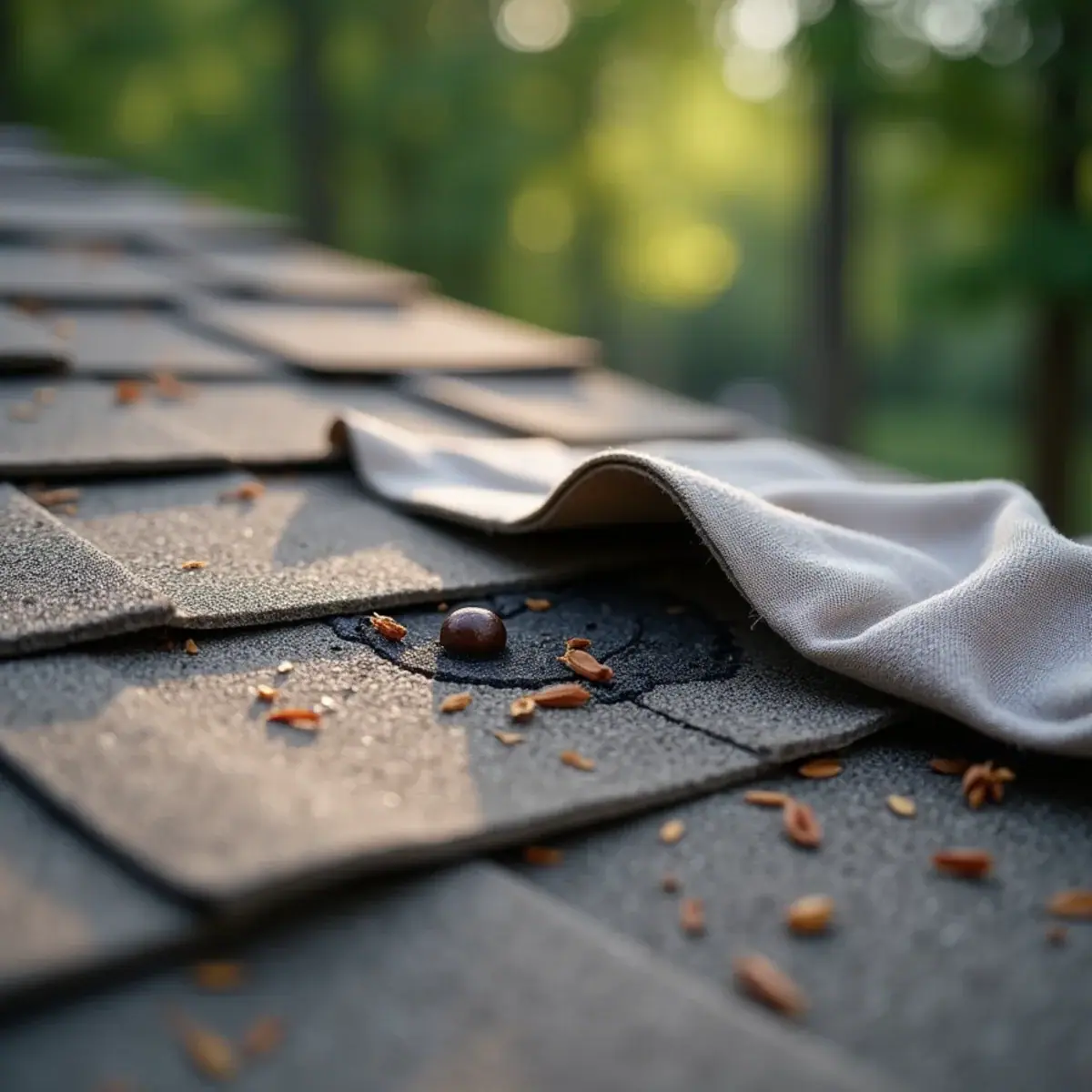
What a missing shingle repair includes
A shingle repair is more than sliding a new piece into the gap. Here is what the roofer we send should cover on the visit.
- A close look at the damaged area and the shingles around it, checking for brittleness, lifted seals and popped nails.
- A check of the underlayment and deck under the missing pieces before anything is covered.
- Identification of your shingle brand, line and color, or the closest match in current stock.
- Careful removal of damaged shingles and their nails without tearing the courses above.
- New shingles nailed on the manufacturer's nail line and sealed down.
- Resealing of nearby lifted tabs and fixing popped nails in the same area.
- Before and after photos, plus a written estimate you approve before work starts.
From the first call to a sealed patch
Most shingle repairs take a single visit. Here is how one usually runs.
- Tell us what you seeCall any hour and describe it: a shingle in the yard, a bare spot on the ridge, a row curling up. A photo from the ground helps if you have one.
- A roofer checks it up closeWe connect you with an independent licensed roofer who looks at the damaged spot and the shingles around it, and checks the attic if there is any staining inside.
- Match and estimateThe roofer identifies your shingle and finds the closest match, then gives you photos and a written estimate. You approve it before any work happens.
- Repair and resealDamaged shingles come out, new ones go in on the correct nail line, and the tabs are sealed down. Nearby popped nails and loose tabs get the same care.
- Look again after a hot weekSummer sun finishes the bond on the new seal strips. After a few warm days, check from the ground. The patch should lie as flat as its neighbors.
Lifted, creased or just worn? Reading shingle damage before the repair
From the yard, lifted, creased and worn shingles can all look like the same dark line. Up close they are different problems, and only one can be sealed back down.
| What the roofer sees | What it means | Usual fix |
|---|---|---|
| Tab edge raised, but it bends back flat without cracking | The seal strip let go; the shingle itself is sound | Reseal by hand, check the nails |
| A straight line across the tab with cracked granules along it | The tab was bent back hard and the mat inside is broken | Replace the shingle, even if it lies flat |
| Black asphalt showing in patches | The shingle has worn or been scuffed bare | Replace those pieces; many bare patches is a bigger talk |
A crease matters more than people expect. Once a tab folds back, the fiberglass mat cracks along the fold and never springs back, so sealant on top only hides it while sun and water work into the break.
Granules in the gutter
Some shedding is normal for a few weeks after new shingles go on. Steady piles from an older roof, or bare spots on the sunny slopes, mean the shingles are wearing out.
3-tab or architectural shingles: what changes in a repair
Look at the roof from the street. Flat, even rows with regular slots mean 3-tab shingles. A layered surface with uneven shadow lines means architectural shingles, also called dimensional or laminated.
| 3-tab shingles | Architectural shingles | |
|---|---|---|
| Where you see them | Older roofs and many rental homes | Most roofs installed since the 2000s, including much of west Little Rock and Chenal Valley |
| How they look | One flat layer with even slots | Two bonded layers with a varied shadow line |
| Matching | Color is the hard part; the shape is simple | Shape and color both matter, and brands differ in pattern |
| Repair note | Thin and often brittle with age, so neighbors crack when lifted | Heavier and easier to lift, though old laminate can split apart |
Timing matters on old 3-tab shingle repair. In winter the roofer may wait for a warmer afternoon, because cold, aged 3-tabs snap when lifted. In midsummer, hot shingles scuff under boots, so early morning work is common.
Architectural shingle repair is more about appearance: without the same shadow pattern, a patch stands out even when the color is close.
Matching new shingles to a sun-faded roof, including discontinued lines
New shingles never look exactly like ten-year-old ones on day one. Arkansas sun fades the granules, and algae darkens them. The goal is a match that blends within a season or two.
- Identify the shingle. The roofer checks the brand, line and color, from a spare bundle in the garage, a loose shingle or a close look on the roof.
- Check local stock. Supply houses around Little Rock carry the common lines, and a close color in the same profile is often easy to get.
- Plan for discontinued lines. If your shingle is no longer made, the roofer finds the nearest color and profile, or borrows matching shingles from a hidden back slope and puts the new ones there.
- Show you first. You should see the proposed shingle next to yours before it goes on.
Keep the spare bundle
If the last roofer left a partial bundle in the garage or attic, hang on to it. It is the closest match you will ever get.
More on this in can you replace just a few shingles.
Ridge cap, starter strip and eave repairs
The peaks and edges of a roof take the most wind and sun, so they tend to fail first.
Ridge cap
Cap shingles along the peak and hips are fully exposed. They crack along the fold, lose their seal and blow off. Ridge cap repair means new cap shingles nailed in the right spot and sealed, and on a vented ridge, a check of the ridge vent underneath.
Starter strip
The first course at the eave carries an adhesive strip that holds the bottom row of shingles down. When it was skipped or put on wrong, the lowest row lifts and peels in the first strong gust. The roofer adds or renews the starter course along the affected run.
Eaves and drip edge
Where overflowing gutters soak the roof edge, the wood behind the shingles starts to rot. If the fascia or the edge of the deck has gone soft, that part is handled with roof decking repair. Bent or missing metal drip edge is covered on our roof flashing repair page.
How a spot repair is done: unseal, replace, re-nail, reseal
A good shingle patch repair is careful flat-bar work: damaged shingles come out without wrecking the good ones around them.
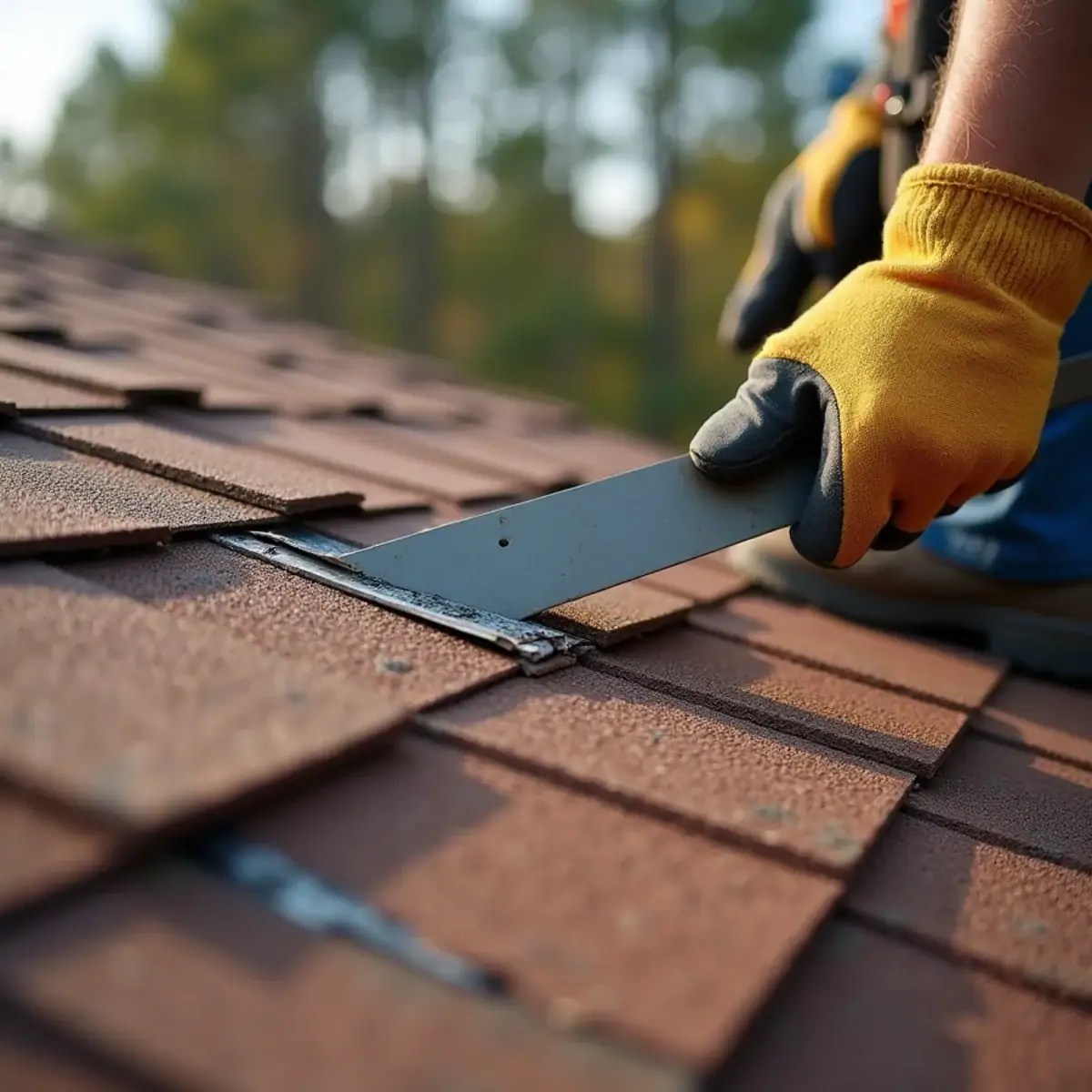
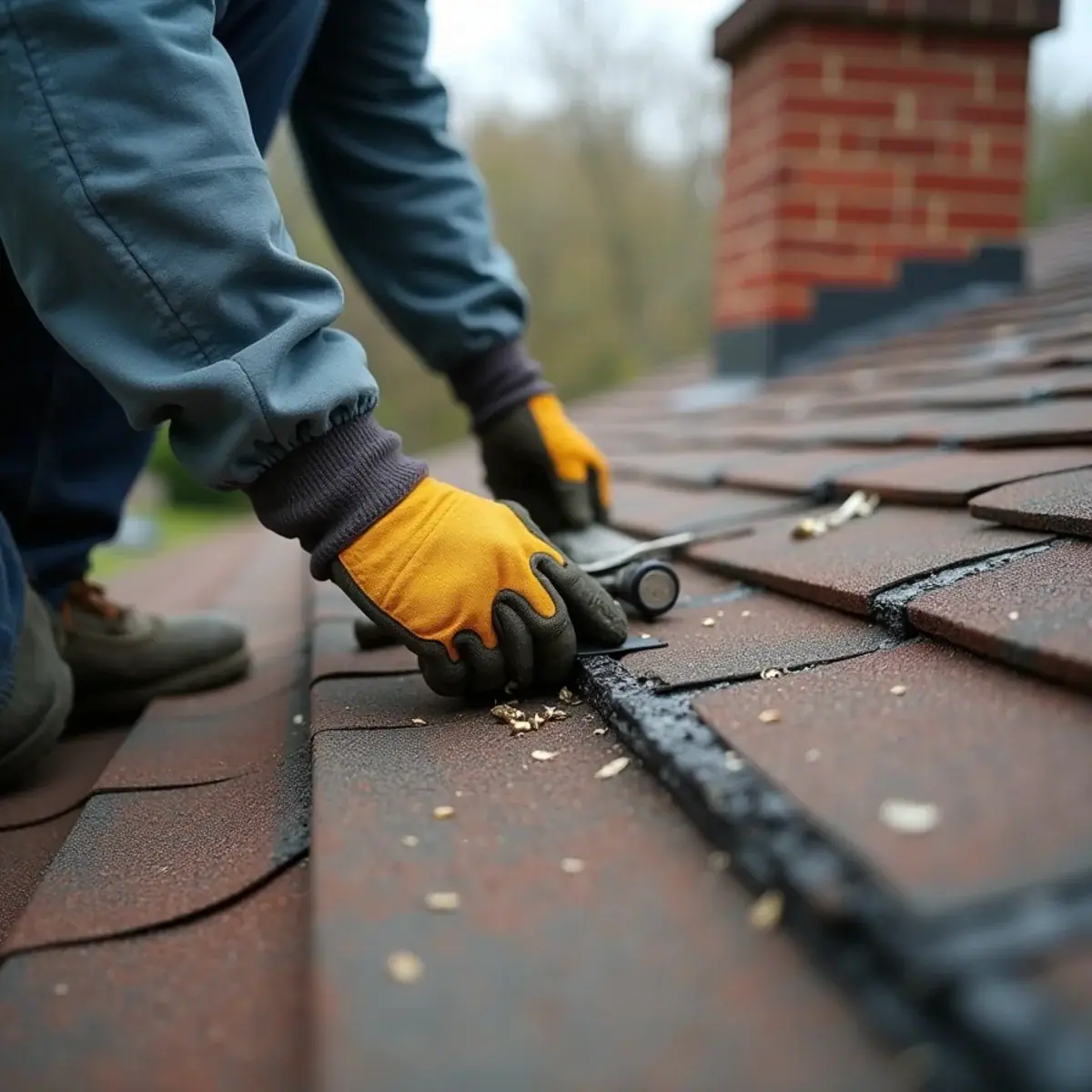
- Break the seal. A flat bar slides under the course above to release the sealant strip, one tab at a time.
- Pull the nails. The nails holding the damaged shingle come out, along with the nails from the course above that pass through it.
- Check underneath. The roofer looks at the underlayment and deck. Torn underlayment is patched, and soft wood is flagged before anything gets covered.
- Slide in the new shingle. It goes in under the course above, lined up with its neighbors.
- Nail it right. Nails go on the manufacturer's nail line. Nails set too high are a common reason patches blow off.
- Reseal. The lifted tabs above get a dab of roofing sealant so they hold until summer heat bonds them on their own.
A small patch usually takes a few hours. The method is the same across all our service areas around Little Rock, on steep Heights bungalows and low-slope ranch homes alike.
Seal strips: why shingles let go, and why new ones may not seal in cold weather
Every modern shingle carries a strip of asphalt adhesive that softens in the sun and glues each course to the one below. That bond keeps the tabs down in a gust. When tabs peel off a roof that otherwise looks fine, the back of the loose shingle often shows a clean strip with nothing torn from the course below: it never bonded. Dust on the strip at install, nails driven through it, or years of heat drying it out do the same thing.
The strip needs warmth and sunshine to activate. A patch put on during a Little Rock cold snap may sit unbonded for weeks, and an unbonded tab is exactly what lifts first. That is why shingle makers call for hand-sealing in cold weather.
- Spots, not a smear. Small dabs of asphalt roofing cement go under each tab, set back from the edge so they don't squeeze out and show.
- The neighbors too. The courses that were lifted to make room for the new shingle get the same treatment, since their old bond was broken on purpose.
- Pressed flat. Each tab is pressed down into the cement so it holds right away instead of waiting for summer.
Nail count, nail placement and older shingle sizes
Each shingle is held by two rows of nails: its own, and the nails of the course above, which pass through its top edge. That is why a proper repair releases the seal on two courses above the damage, not one.
How many nails, and where
The manufacturer's instructions set the count, commonly four nails per shingle and six for high-wind installs or very steep slopes. The shingle's wind rating assumes that pattern. Placement matters as much as count:
- Nails go in the printed nailing zone, just below the seal strip. Nails set higher can pull through or leave the bottom edge loose enough to flap.
- Nails driven through the seal strip keep it from bonding.
- On architectural shingles the nail has to catch both bonded layers. A nail that misses the lower layer holds only half the shingle.
When old and new shingles are different sizes
Older 3-tab roofs may use the traditional size with a 5-inch exposure, while most shingles sold now are larger metric sizes with a 5 5/8-inch exposure. A new piece will not drop straight into old courses, so the roofer trims its length and top edge to line up the slots and lie flat under the course above. Skip that step and the patch humps up and never seals.
Arkansas heat, algae streaks and why shingles curl early
Little Rock summers stay hot and humid for months, and a dark shingle roof runs far hotter than the air. When the attic underneath is poorly vented, heat builds under the deck and cooks the asphalt from below as well. Shingles lose their oils, stiffen, and start to curl and crack years early. South- and west-facing slopes usually go first.
Plenty of older Little Rock homes were built with little soffit venting, and some later got extra attic insulation that blocked what vents they had. If curled shingles cluster on one slope, ask the roofer to look in the attic too. Our guide to attic ventilation and shingle life covers the usual fixes.
What about the black streaks?
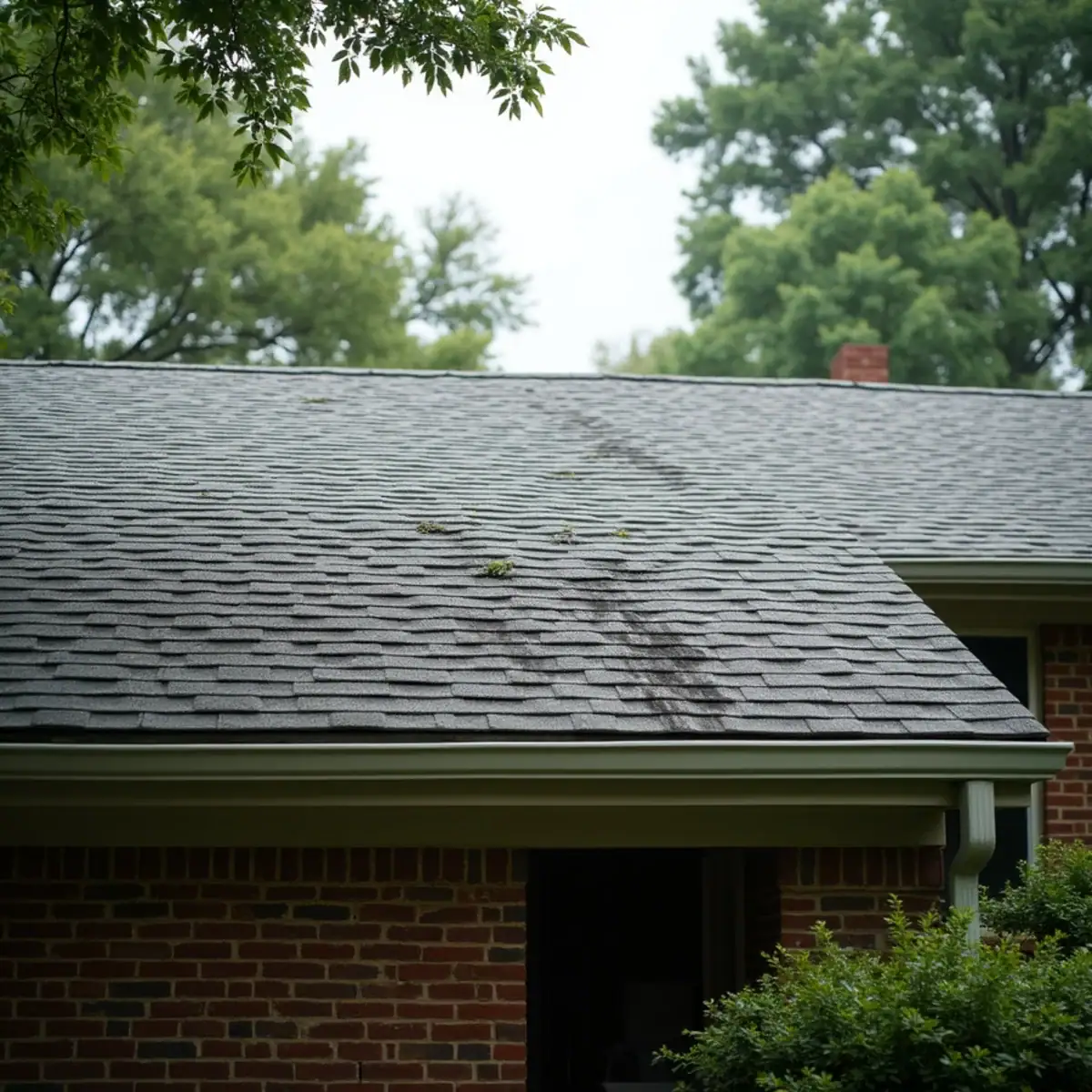
The dark streaks on so many shaded roofs here are mostly algae, which thrives in humid air under oaks and pines. It looks bad but rarely harms the shingle. Moss is different: it holds water and lifts tabs. Never pressure-wash shingles, because it strips the granules. See black streaks on roof shingles.
When a patch stops making sense
Spot repairs are the right answer on most roofs. They stop making sense when the shingles around the damage are failing too, because every repair then creates new damage next to it.
- Shingles break when the roofer tries to lift them, so each patch cracks the pieces around it.
- Curling, cupping or bare spots cover most of a slope, not just a few pieces.
- New missing or lifted shingles keep turning up in different places every few months.
- The deck feels soft in more than one area when the roofer walks the roof.
- Granules are piling up in the gutters and the shingle mat shows through in spots.
If the roofer sees these signs, you get photos and a straight explanation. A full-roof decision is a separate conversation from today's repair, and in the meantime the missing pieces can still be patched so water stays out.
What affects the cost of a shingle repair
Shingle repairs are priced on the job in front of the roofer. The main factors:
- How many shingles, and where. A few tabs on a low eave go faster than a strip along the ridge.
- Shingle type and match. Common architectural lines are easy to source. Discontinued colors and older 3-tabs take more searching, or borrowing from a hidden slope.
- Roof pitch and height. Steep pre-war roofs in Hillcrest, the Heights and the Quapaw Quarter need harnesses and roof jacks.
- Condition of the old shingles. Brittle shingles slow the work, because each one has to be lifted with care.
- What is underneath. Torn underlayment or soft decking adds to the scope.
- Related fixes. Popped nails nearby, a loose ridge cap or a lifted starter row are often worth fixing on the same visit.
Read what shingle roof repair costs in Little Rock for more. The roofer gives you a written estimate before work starts.
Why homeowners call Little Rock Shingle Roofers for shingle repairs
- Answered any hourFound shingles in the yard after a rough night? The line is answered 24/7, so the repair can get on the schedule before the next rain.
- Repair before anything biggerA handful of missing shingles is a repair. The roofer fixes what is damaged and does not talk you into more than the roof needs.
- Photos of every spotYou see the bare spot, the torn underlayment and the popped nails in photos, then the same spots after the work. The written estimate comes first.
- Licensed and insured in ArkansasEvery roofer we send is licensed and insured in Arkansas, and is used to both the steep pre-war roofs and the newer subdivision roofs around Little Rock.
Missing Shingle Repair questions from Little Rock homeowners
Can you replace just a few shingles?
Yes, in most cases. A roofer can break the seal on the courses above, pull the damaged shingles and slide new ones in without disturbing the rest of the roof. It gets harder when the surrounding shingles are so brittle they crack when lifted, and the roofer checks for that before giving you a price. See replacing just a few shingles.
Will the new shingles match my old roof?
Not always exactly. New shingles start out brighter than ones that have weathered for years in Arkansas sun, and some colors are discontinued. The roofer finds the closest color and profile in current stock, shows it to you before installing, and can move shingles from a hidden slope to the front if the match matters there. Most patches blend within a season or two.
How long can I leave a missing shingle before it leaks?
Not long. The underlayment under a missing tab can keep water out for a while, but it is not built to sit exposed to sun and heavy rain. In a Little Rock summer it can dry out and tear within weeks, and a single hard downpour can find exposed nail holes right away. Get it looked at soon, especially ahead of a rainy stretch.
Is it worth repairing a 20-year-old shingle roof?
Usually, if the shingles around the damage are still flexible and lie flat. Plenty of 20-year-old architectural roofs around Little Rock have years left, and a small repair keeps them dry. If shingles crack when lifted or curl across whole slopes, the roofer will tell you and show you photos. Either way, missing pieces can be patched so water stays out in the meantime.
Why do shingles on the sunny side of my roof curl first?
South- and west-facing slopes take the most direct afternoon sun in Little Rock, so the asphalt dries out faster there. A poorly vented attic adds heat from below. That is why one slope can look tired while the north side still looks fine. The roofer can swap out the worst shingles and check whether attic ventilation is part of the cause.
What should I do with a shingle I find in the yard?
Keep it. A loose shingle tells the roofer the brand, color and profile, which makes matching easier, and the back can show whether the seal strip had already failed. If you can see the gap from the ground, take a photo showing where it came from. Don't climb up to check it yourself, especially on a steep or wet roof.
Can missing shingles be replaced in winter?
Yes. The roofer picks milder days, because cold, aged shingles crack when lifted, and cool weather is actually the cleanest time to break old seal strips (on hot afternoons the adhesive turns gooey). Since the new strip won't activate in the cold, every replaced and lifted tab is hand-sealed so it holds until spring.
Why do replacement shingles sometimes lift a few weeks after a repair?
Usually one of three things. The patch went on in cool weather and was never hand-sealed, so the tabs sat loose. The nails went above the nailing zone or through the seal strip. Or a newer, larger shingle was forced into older, smaller courses without trimming, so it humps and can't bond.
Does a creased shingle need replacing if it is lying flat again?
Usually, yes. A crease means the tab was bent back far enough to crack the mat inside, and that break stays even after the shingle settles back down. The tab often tears off along the fold later. A lifted shingle that bends without cracking is different: it can often be resealed instead of replaced.
Page reviewed by Little Rock Shingle Roofers.